
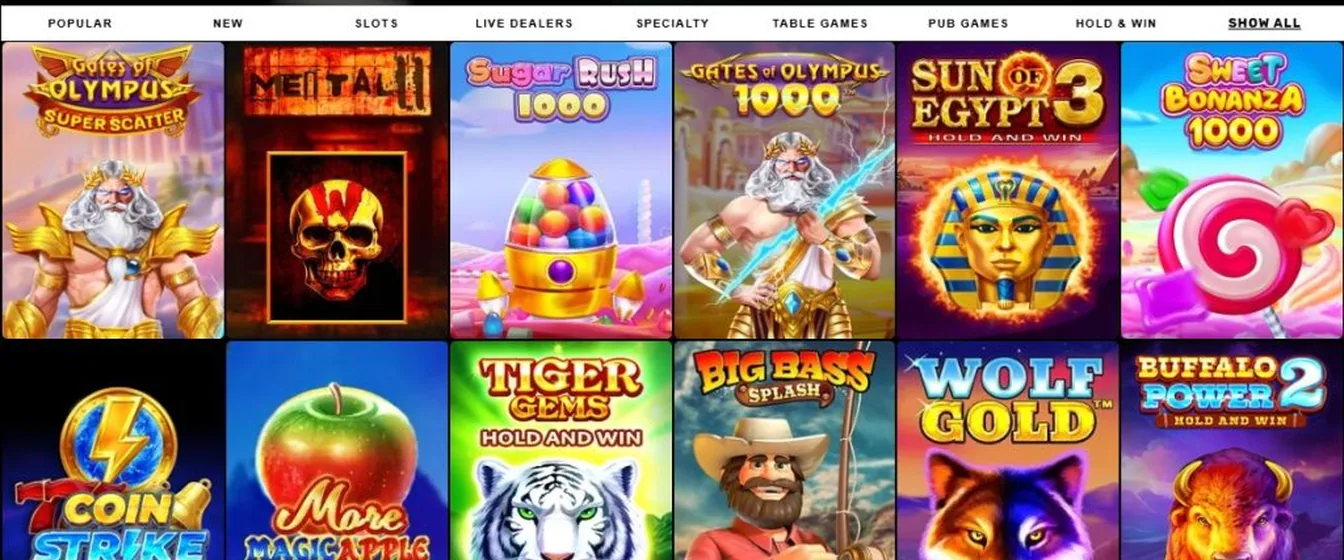
What is in the casino
The Pokies Net casino is organised the way an Australian player expects: pokies first and everything else arranged around them. The library covers video pokies, jackpot titles, live dealer tables, card and table games, and a smaller set of instant-outcome games. All of it runs in a browser - there is no client to install and no separate download for any category.
Size alone is a weak signal. A library of two thousand titles assembled from three studios has less variety than four hundred titles drawn from a dozen, because a studio's design language repeats across its catalogue. What follows is the useful version of the question: who builds what, and what does each format actually do.
The studios building the games
No casino develops its own pokies. Games are licensed from independent studios, which also means the casino cannot alter how any of them behave - the mathematics ships inside the game, from the studio, already certified.
| Studio | Known for | Type |
|---|---|---|
| Hacksaw Gaming | High-volatility modern titles such as Wanted Dead or a Wild | Pokies |
| NetEnt | Long-running classics including Starburst and Gonzo's Quest | Pokies |
| Play'n GO | Book of Dead and a deep back catalogue of book-style pokies | Pokies |
| Big Time Gaming | Originated the Megaways reel mechanic used across the industry | Mechanic |
| Evolution | Live dealer studios — Lightning Roulette, Crazy Time, blackjack tables | Live |
| Nolimit City | Mechanically heavy titles like Mental and San Quentin | Pokies |
| Yggdrasil | Vikings Go Berzerk and the Gigablox mechanic | Pokies |
Why the studio name predicts the experience
Studios have signatures. One builds high-volatility titles where most spins return nothing and the feature carries the entire session. Another builds steady, frequent-payout games with modest ceilings. A third specialises in a single mechanic and licenses it outward - Megaways is the obvious case, originated by Big Time Gaming and now running under dozens of other studios' badges. Learning three or four names you enjoy is a faster route to a good session than scrolling a lobby.
Pokie formats, and what each one actually does
Ways to win
Instead of fixed paylines, matching symbols pay wherever they land on adjacent reels. A 243-ways game is not paying 243 separate lines - it is paying any left-to-right adjacency. It produces more frequent small wins and a flatter distribution, and it is the structure most club-floor Australian machines used.
Hold and spin
Special symbols lock in place and the remaining positions respin, usually with three attempts that reset each time a new symbol locks. It is a self-contained mini-game with a visible objective, which is exactly why it became the dominant feature format - the player can see how close the board is to filling.
Cluster pays
No reels and no lines. Symbols pay when a group of them touch, then vanish and let new symbols fall into the gap, often with a multiplier that climbs through the chain. One spin can resolve into a long sequence, which makes the format feel slower and more eventful than its actual spin count suggests.
Megaways and variable reels
The number of symbols on each reel changes every spin, so the number of winning combinations changes with it - anywhere up to 117,649 in the standard implementation. High variance is intrinsic to the design rather than a tuning choice.
Volatility, RTP and what they actually tell you
These two numbers get quoted constantly and understood rarely. They describe different things and neither predicts a session.
Return to player is a long-run average, computed across millions of simulated spins. A 96% RTP does not mean $96 back from $100. It means that across an enormous sample the machine returns 96% - and your afternoon is not an enormous sample.
Volatility describes how that return is distributed. A low-volatility pokie pays small amounts often; a high-volatility one pays rarely and large. Two games can share an identical RTP and produce completely different sessions, which is why volatility, not RTP, is the number worth matching to your budget. A small bankroll on a high-volatility title runs out before the maths has room to work.
Jackpots and how they are funded
Three structures, and they behave nothing alike.
Progressive jackpots take a slice of every wager placed across every casino running that game and add it to a shared pool. The pool grows until somebody wins it, then resets. The prize is enormous and the odds are correspondingly remote, and the funding slice comes out of the base game's return - which is why progressive titles often have a lower effective RTP outside the jackpot.
Fixed jackpots are a top prize in the paytable. They do not grow and they are not shared.
Daily or timed drops must pay before a deadline, which changes the shape of the odds as the window closes rather than the size of the prize.
Live dealer tables
Live dealer is a video stream from a studio with a real dealer, real cards and a real wheel, and bets placed through an overlay on your screen. Roulette, blackjack and baccarat form the core, with game-show formats built around wheels and multipliers sitting alongside.
Two practical notes. It is the heaviest thing on the site for data and battery, because it is continuous video rather than a static lobby. And it usually contributes little or nothing toward bonus wagering requirements, so clearing a bonus at a live table is often arithmetically impossible before the offer expires.
Trying a game before you stake anything
Most pokies run in a demo mode with play money. It costs nothing and it answers the only questions that matter before a deposit: how often does this thing pay, how long does the feature take to arrive, and does the rhythm suit me. Ten minutes in demo eliminates most of the games you would otherwise have paid to eliminate.
Demo mode cannot be used to clear a bonus and cannot pay real winnings. It is a test bench, and used as one it is the single most useful free tool on the site.
Funding play
The games are the reason to be here, but the cashier is what determines whether the session starts smoothly. PayID and Osko settle in close to real time on the domestic rails; cards authorise instantly on the way in and move slowly on the way back; crypto is finalised by block confirmations, which pay no attention to bank opening times.
| Method | Type | How it settles |
|---|---|---|
| PayID | Bank transfer (NPP) | Money lands in seconds between banks on the platform, weekends included |
| POLi | Bank redirect | You authorise it in your own bank; nothing can travel back along it |
| Neosurf | Prepaid voucher | Prepaid and bought with cash, which makes it inherently deposit-only |
| BPAY | Bill payment | Batched overnight instead of settled live - typically one or two days |
| Visa | Card | Authorises immediately inbound; a return payment moves on scheme timing |
| Mastercard | Card | As with Visa, and certain banks decline gambling categories outright |
| Bank transfer | Direct entry | Legacy direct entry - one to three business days and no weekend runs |
| Bitcoin | Crypto | Settlement is a count of confirmations, not an office schedule |
| Ethereum | Crypto | Timing tracks congestion on the chain and the gas you are willing to pay |
Licensing behind the library
The operator's permission to run these games comes from Curacao master licence 1668/JAZ, registered to Cyberluck Curacao N.V. For the games specifically, the relevant assurance is not the casino's licence but the studios' certification: the random number generator sits inside the studio's game and is tested by independent houses, and the casino licenses the title as built without the ability to alter its return.
How the lobby is organised
Categories on a casino front page are merchandising rather than taxonomy. New releases and popular titles are promoted positions; the real structure sits in the filters underneath - by studio, by mechanic, by volatility where the site exposes it. Learning the filters is what turns a wall of thumbnails into a library.
| Category | What it contains | Best for |
|---|---|---|
| Pokies | The bulk of the library, across every mechanic | Bonus wagering, since these usually contribute in full |
| Jackpots | Progressive, fixed and timed-drop titles | Large ceilings, at long odds |
| Live casino | Streamed tables with human dealers | Table play; poor for clearing bonuses |
| Table games | Software blackjack, roulette, baccarat | Faster rounds and lower minimums than live |
| Instant games | Crash, dice and scratch formats | Short sessions with a visible risk control |
Choosing a title to match a bankroll
The single most useful filter is not theme or studio, it is volatility, because volatility decides whether a balance survives long enough to reach the part of the game worth playing. A feature that triggers every two hundred spins is unreachable on a balance that lasts eighty.
| Volatility | Session shape | Suits |
|---|---|---|
| Low | Frequent small returns, shallow swings | Long sessions on a modest balance; clearing wagering |
| Medium | A mix, with features arriving regularly | General play without a specific goal |
| High | Long dry runs punctuated by large outcomes | Larger balances, and patience for the gaps |
Studios publish these ratings and most lobbies surface them. Where a title does not state one, the demo answers it faster than any review: ten minutes of play money shows you the rhythm at no cost.
Feature buys, and why the maths does not change
Many modern pokies let you purchase the bonus round directly for a multiple of the stake - typically around a hundred times. It is presented as a shortcut and it is priced as one: the studio sets the cost so that the expected return of the purchase is close to the game's ordinary return, not better.
Two practical warnings. A feature buy is an enormous single stake, which compresses a session dramatically. And because it is a single large wager, it breaches the maximum bet clause on almost every bonus - one purchase while wagering is outstanding is enough to void the bonus and everything won from it.
What live dealer costs to run
Live tables stream continuous video, which makes them the heaviest thing on the site for both data and battery. On a capped mobile plan an hour of live play is comparable to an hour of standard-definition streaming; the lobby and the pokies are a fraction of that. Wi-fi is the sensible default for table sessions.
Software tables versus live tables
The same game appears twice in most lobbies, once as software and once as a live stream, and they are not interchangeable. Software blackjack resolves in seconds, accepts very small stakes and is available instantly. Live blackjack runs at the pace of a human dealer and a shared table, carries higher minimums, and is limited by seat availability at busy hours.
For anyone learning a game, software is the better classroom: the pace is yours, the minimums are low enough that mistakes are cheap, and nobody at the table is waiting on your decision. Live is the better experience once the decisions are automatic.
Reading a paytable properly
Every pokie carries a paytable, and almost nobody opens it. It is the only place the game explains itself: what triggers the feature, how many scatters are required, whether the top prize is fixed or progressive, and what the maximum win is expressed as a multiple of the stake.
That last figure is the most useful and the least quoted. A game capped at 500x and a game capped at 20,000x can carry the same advertised return, but they are completely different propositions - the first pays more often and smaller, the second is built around an outcome most sessions never see.
Where the feature actually lives
Look for the trigger condition before playing. Three scatters anywhere is a common and reachable trigger. Three scatters on specific reels is considerably rarer. A feature that requires filling a meter across many spins is a long-session mechanic and will simply not appear in a short one, regardless of stake.
Session pacing and autoplay
Autoplay is a convenience that removes the only natural brake in the game - the decision to press the button again. Where it is used, the loss limit and single-win stop conditions are worth setting, because they turn an open-ended run into a bounded one before it starts.
Turbo and quick-spin settings compress the same number of outcomes into less time. They do not change the mathematics at all, but they change how much of a balance is resolved per minute, which is worth knowing before switching them on.
New releases, and whether they are worth the click
Lobbies promote new titles heavily because novelty drives engagement, not because new games pay better. A release from a studio you already enjoy is worth a look on that basis alone; a release promoted purely for being new carries no information.
The exception worth watching is a studio's sequel to a title that did well. Those usually keep the mechanic that worked and adjust the volatility, which means the experience is predictable in a way a genuinely new format is not.
Tournaments and leaderboards
Prize drops and leaderboard races run alongside the ordinary library, ranking players by wagering volume or by the size of a win relative to stake. Entry is usually automatic on qualifying games.
Read which of the two it is before playing toward it. A volume leaderboard rewards staking more and is effectively unwinnable against high-stakes players. A multiplier-based race, ranking the largest win relative to the bet, is genuinely open to a small stake - which is a completely different proposition on the same page.
Games you can play right now
 The Dog HouseFishing collect
 Gates of Olympus 1000Multiplier orbs
 PompeiiSugar cluster
 Best BetClub floor ways
 Chests of Cai ShenHold and spin
 SpacemanTimed jackpot
 Blackjack VIPRetrigger round
 Blackjack LiveRising multiplier
 Super Mine BrosFeature purchase
 Cash ItWild expansion
 4 Pots RichesChain reaction
 Big Bass SplashThree scatters